
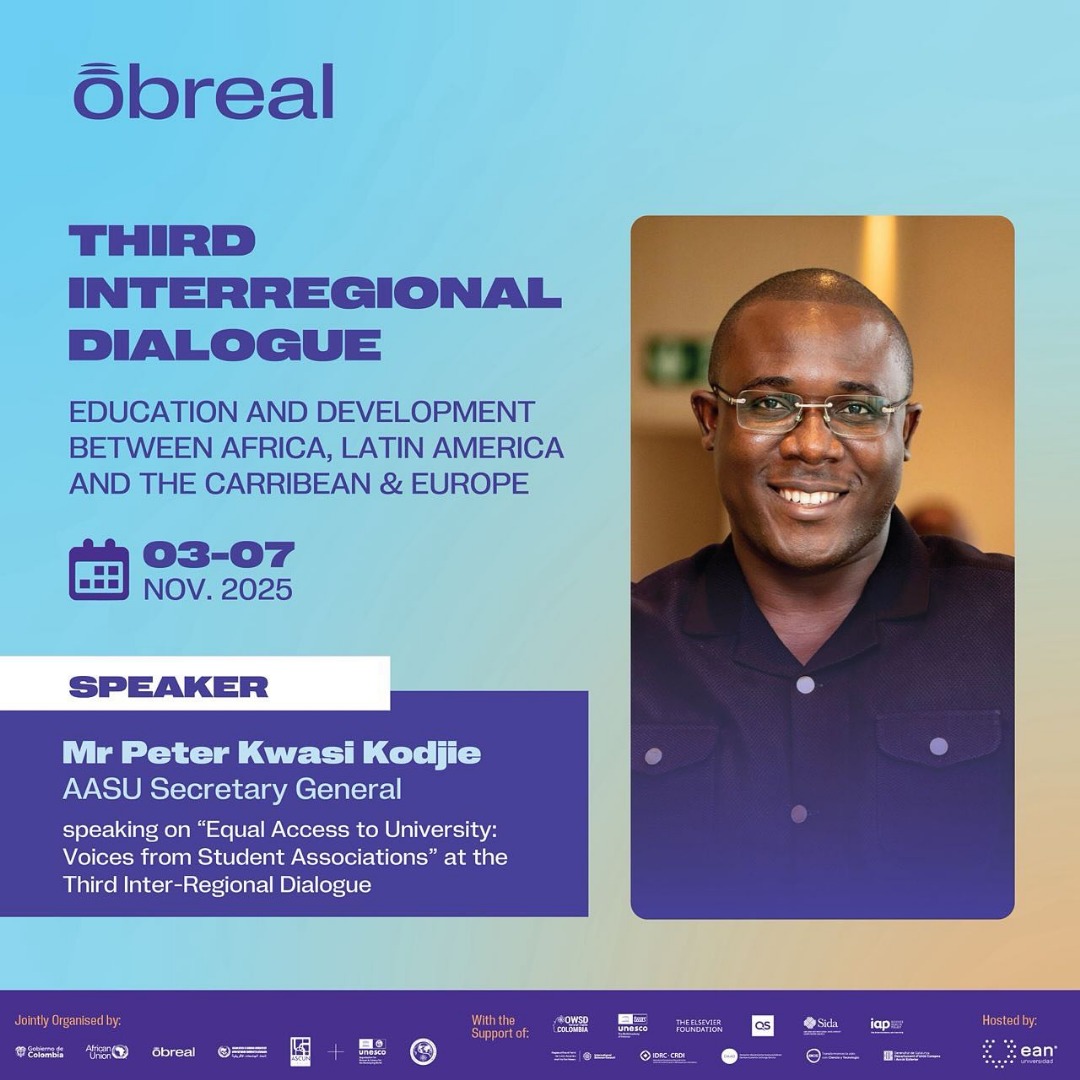
The All-Africa Students Union (AASU) represented the voice of African students at the Third Interregional Dialogue on Education and Development, held in Bogotá, Colombia, from November 3–7, 2025. The high-level forum, a key platform for fostering cooperation between the African Union (AU) and the Community of Latin American and Caribbean States (CELAC), brought together governments, universities, and development actors to advance joint action in education, science, and sustainable development.
The dialogue, co-organized by the Government of Colombia, the African Union, Obreal, the Colombian Association of Universities (ASCUN), and the Association of African Universities (AAU), aimed to generate innovative responses to the most pressing global challenges facing the Global South.
At the heart of the discussions was the critical session on “Equal Access to University: Voices from Student Associations,” featuring Mr. Peter Kwasi Kodjie, Secretary-General of AASU. In a powerful address, Mr. Kodjie articulated a bold vision for educational justice and South-South cooperation, framing education as the fundamental bedrock of societal progress.
“Education is not a privilege – it is the foundation upon which every just and equitable society is built,” he stated, setting the tone for a call to action.
Mr. Kodjie challenged the prevailing narratives of dependency, asserting, “The Global South can and must finance its own education future through models driven by local ownership and innovation.” He pointed to existing mechanisms like Ghana’s GETFund as examples of home-grown solutions, declaring, “From Ghana’s GETFund to the rest of the Global South – we can build systems that reflect our realities.”
The Secretary-General’s remarks consistently underscored the catalytic role students play in driving change. “When students lead, nations listen – the push for inclusive education has always begun with student voices,” he affirmed, positioning AASU and its global partners as indispensable actors in the policy landscape.
He redefined the purpose of international collaboration, stating, “South–South cooperation in education is not charity; it is the blueprint for self-reliance and shared progress.” This vision positions Africa, Latin America, and the Caribbean as mutual architects of their own destinies, moving beyond traditional aid models.
Emphasizing the non-negotiable role of public education, Mr. Kodjie proclaimed, “Public education is the great equalizer – it must never be surrendered to profit or privilege,” and powerfully concluded that “A nation’s true wealth lies not in its natural resources but in the minds it chooses to educate.”
AASU’s participation in this strategic dialogue reinforces its commitment to shaping a global education agenda that is inclusive, equitable, and driven by the collective power and innovation of the Global South. The union continues to bridge continents, ensuring that the student perspective remains central to building a future where every learner, regardless of origin, has the right to learn, dream, and build.